Real Estate Commission Calculator
Instantly calculate your gross and net commission based on sale price, broker split, and referral fees.
Understanding Real Estate Commission Calculations
Real estate commissions are typically calculated as a percentage of a property’s final sale price. That total commission is then divided between the listing brokerage and buyer brokerage and further split between the broker and agent according to agreed brokerage terms.
Referral fees may also apply if a transaction originates from another agent or relocation network. These deductions can significantly impact an agent’s take-home earnings.
Using a real estate commission calculator helps agents estimate gross commission, brokerage splits, referral deductions, and final net income before closing. Whether you're comparing brokerage structures or planning income goals, understanding your true payout is essential for financial clarity and business growth.
How Real Estate Commissions Are Calculated
Real estate commissions are typically calculated as a percentage of the final sale price of a property. In most markets, total commission ranges from 5% to 6%, which is then split between the listing brokerage and the buyer’s brokerage.
However, what many agents overlook is how brokerage splits, referral fees, and cap agreements impact take-home income. A commission that appears substantial at closing may be reduced significantly once brokerage percentages and referral deductions are applied.
Using a real estate commission calculator helps agents estimate their net commission more accurately before a transaction closes.
Why Commission Planning Matters for Agents
Understanding commission structure is essential for income forecasting, brokerage comparisons, and long-term production planning.
Our calculator helps agents:
Estimate gross commission
Compare brokerage split scenarios
Project net income from transactions
Analyze cap progress
For more detailed split comparisons, visit our Broker Split Calculator.
Are you wondering how close you are to keeping 100% of your commission? Use our Broker Cap Calculator next!
Real Estate Commission 101: How to Calculate Your GCI and Net Take-Home


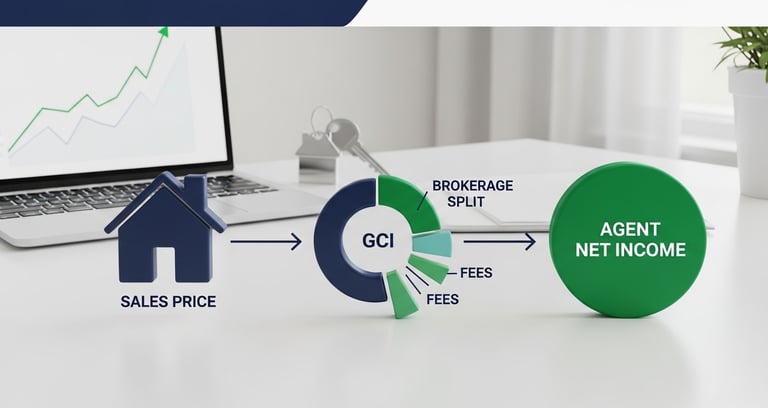
For many real estate agents, the most exciting part of the job is the moment a deal closes. However, the "total commission" listed on the settlement statement is often quite different from the amount that finally lands in your bank account due to various deductions such as brokerage fees, taxes, and other expenses that can significantly reduce your earnings. To run a successful and sustainable real estate business, you must master the math of Gross Commission Income (GCI) versus your Net Commission.
Using a real estate commission calculator is the best way to visualize these numbers instantly, allowing you to plan your taxes, marketing budget, and personal finances with precision.
What is Gross Commission Income (GCI)?
GCI is the total dollar amount earned from a real estate transaction before any deductions, splits, or expenses are applied. It is calculated based on the final sales price of the home.
The Formula: Final Sale Price × Commission Percentage = GCI
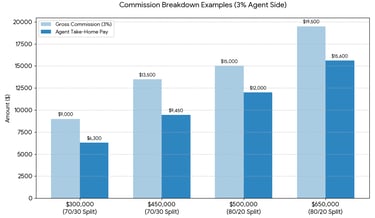
For example, if you sell a home in Birmingham for $400,000 and the commission for your side of the deal is 3%, your GCI is $12,000. While this looks like a significant payday, it represents the revenue of your business, not your personal salary.
The "Split" with Your Brokerage
Unless you are a managing broker yourself, you likely work under a brokerage that provides legal oversight and resources. In exchange, they take a "split" of your GCI.
If you are on a 70/30 split, using the $12,000 GCI example above:
The Brokerage keeps 30% ($3,600).
You keep 70% ($8,400).
This is often the largest deduction from your commission check, but it isn't the only one.
Typical Deductions to Expect
Before you see your net profit, several "off-the-top" or "per-file" fees may be deducted:
Franchise Fees: Many national brands charge a 5%–8% franchise fee on every deal.
Transaction Coordinator Fees: If you hire a professional to manage your paperwork, this is typically paid out at closing.
E&O Insurance: Most brokers charge a small fee per transaction to cover professional liability insurance, which protects against claims of negligence or inadequate work.
Referral Fees: If the lead was sent to you by another agent, you may owe a 25%–35% referral fee from the GCI.
Desk Fees: Fees paid by real estate agents to their brokerage for office support, resources, and the right to operate under the broker’s license.
Desk fees are regular payments that real estate agents make to their brokerage in exchange for access to office resources, support services, and the ability to operate under the brokerage’s license. These fees may be charged monthly, annually, or per transaction and often cover expenses such as office space, administrative support, technology platforms, marketing tools, and training programs.
Some brokerages charge a flat desk fee regardless of production, while others combine desk fees with commission splits or transaction fees. The structure varies by brokerage and can affect an agent’s overall earnings and cost of doing business.


The Impact of the NAR Settlement on Commissions
It is important to note that as of late 2024, the way commissions are communicated and paid has shifted. Commission rates have always been negotiable, but they are now more transparent than ever. Whether a commission is paid by the seller as a concession, which is a reduction in the sale price, or directly by the buyer, the fundamental math of GCI (Gross Commission Income) remains the same. Staying informed on these changes ensures you can explain your value to your clients clearly and confidently.
Calculating Your Real Net Profit
To truly understand your income, you must also subtract your operating expenses. These are the costs you pay out-of-pocket to earn that commission, such as:
Professional photography and staging
Social media advertising and lead generation
Gas and vehicle maintenance
NAR and local MLS dues
A "high value" agent considers the profit margin after all costs, not just the check size.
Why Use Our Commission Calculator?
Real estate is a business of momentum. By using our Commission Calculator, you can quickly run "what-if" scenarios. For instance, if you increase your average sales price by $50,000, how does that impact your end-of-year take-home?
Don't leave your financial future to guesswork. Plug your numbers into the tool above to see exactly where your business stands today.
The Strategic Agent: Beyond the Gross Commission Income (GCI)
As a licensed broker with 30 years in the industry, I’ve noticed that the most successful agents don’t just focus on the sale; they focus on their net profitability. Whether you are affiliated with a national brand like eXp or KW or working within a boutique local firm or a new home construction builder, understanding how your commission translates into actual take-home pay is the foundation of a sustainable real estate career.
Why Every Professional Needs a Precision Calculator
In a nationwide market where split models, caps, and royalty fees vary significantly by brokerage and region, a "rough estimate" of your commission isn't enough. We designed this calculator to assist you, the professional agent, in visualizing your true earnings after accounting for all deductions.
The Three Pillars of Commission Analysis
When using this tool to project your business growth, keep these three professional factors in mind:
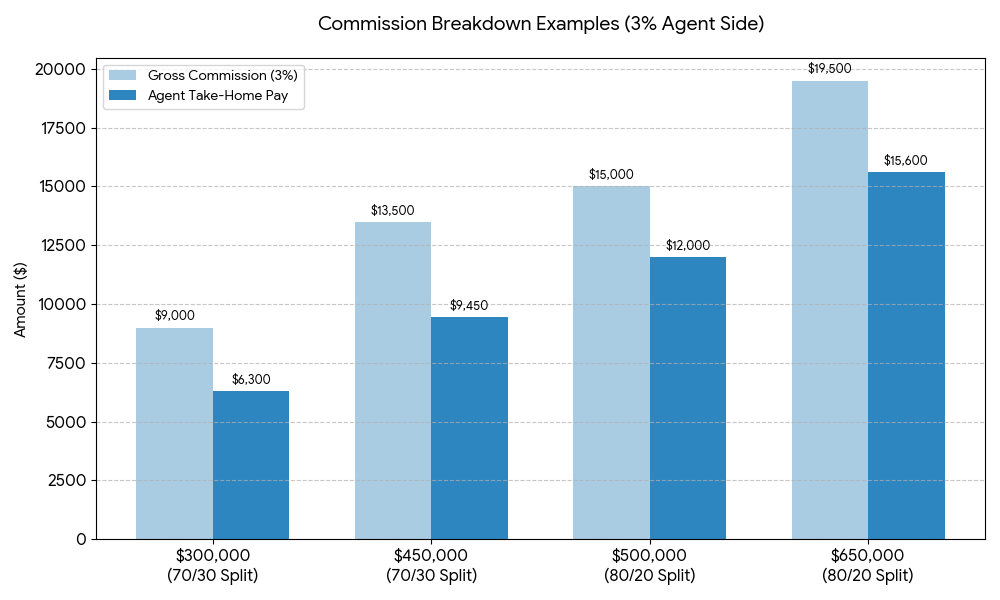
The Split and Cap Dynamic: Most modern nationwide brokerages operate on a split model (e.g., 70/30 or 80/20) with an annual cap. Knowing exactly when you "cap" and begin receiving 100% of your commission is vital for your Q3 and Q4 financial planning.
Transaction and Franchise Fees: Many agents overlook the "off-the-top" expenses, which are costs deducted from their earnings before they receive their commission. Whether it's a 6% franchise fee or a flat per-transaction fee, these small percentages can significantly impact your annual GCI (Gross Commission Income, which is the total commission earned before any deductions).
Self-Employment Tax and Reinvestment: As independent contractors, remember that the number you see on this calculator is your gross professional income. I always recommend setting aside a consistent percentage for estimated taxes and reinvesting at least 10% back into your personal brand and lead generation.
A Broker’s Perspective on Nationwide Trends
In 2026, the industry is seeing a shift toward more transparent commission structures. As agents nationwide adapt to new regulatory environments and buyer-agency agreements, having a clear, data-driven view of your commission is your greatest competitive advantage.


"Many new agents focus solely on the split, but as a broker who has seen thousands of deals, I can tell you the Cap is where your wealth is built. If you're a high-volume agent, hitting your cap by Q2 means you keep 100% of your commission for the rest of the year. When comparing brokerages, don't just ask, 'What is my split?'—ask, 'How quickly can I reach my cap based on my current average price point?'"
A Broker’s Tip on "The Cap"


Compare additional commission tools designed for real estate agents.
See how referral percentages reduce your commission payout. Use our Referral Fee Calculator to calculate referral fees before and after broker splits.
Related Real Estate Calculators
Compare different brokerage split models. Use our Broker Split Calculator to compare 50/50, 70/30, and 80/20 brokerage models.
Track your progress toward hitting your annual commission cap. Use our Broker Cap Calculator to track progress toward your annual commission cap.
PrimeThread Insight
Many agents underestimate how referral fees and brokerage splits combine to reduce their final commission. Understanding these numbers before closing helps agents forecast income more accurately.
Source: realestateagentcalculators.com