
The Real Estate Referral Fee: How to Calculate Your "Finder's Fee" Profit
What is a Standard Referral Fee?
In the world of real estate, some of the best checks you’ll ever receive are the ones where you didn't have to show a single house or attend a single inspection. Referral fees are a powerful way to monetize your network, but if you don't understand the math behind the "off-the-top" deduction, your final check might come as a surprise.
Whether you are sending a client to an agent in another state or receiving a hot lead from a colleague, using a referral fee calculator is essential for setting expectations and managing your business's cash flow.
In the residential real estate industry, the "standard" referral fee is typically 25% of the gross commission earned by the receiving agent. However, this is entirely negotiable. Depending on the lead quality or the specific market (like high-end luxury or commercial), fees can range anywhere from 20% to 35% or even higher.
The most important thing to remember is that referral fees are almost always calculated based on the Gross Commission Income (GCI) and are paid out before the brokerage takes its split.
How the Math Works (The "Off-the-Top" Rule)
The Formula:
GCI × Referral % = Referral Fee Paid
GCI - Referral Fee = Remaining Commission
Remaining Commission × Broker Split % = Your Net Take-Home
For example, if you receive a referral on a $10,000 commission with a 25% referral fee and you are on an 80/20 split:
The Referral Fee: $2,500 goes to the referring agent.
The Remainder: $7,500 is what is left for you and your broker.
Your Net: You keep 80% of that $7,500, which is $6,000.
Without a calculator, it’s easy to mistakenly calculate your split on the full $10,000, leading you to believe you’re making $8,000 when you’re actually making $6,000. That’s a $2,000 difference !
Why Send Referrals?
Some agents are hesitant to send referrals because they "lose" 25% of the deal. However, smart agents view referrals as 100% profit on 0% of the labor. * Out-of-Area Clients: If a past client is moving from Birmingham to Dallas, you can't realistically serve them. Referring them to a vetted agent in Dallas ensures your client is taken care of and earns you a "thank you" check for simply making a phone call.
Specialization: If you specialize in residential homes, but a client wants to buy a poultry farm, referring them to a land specialist protects the client and saves you from the liability of working outside your expertise.
The Legal Side: Real Estate Referral Agreements
To ensure you actually get paid, you must have a signed Referral Agreement in place before the transaction closes. Most brokerages have a standard form for this. Because commissions must technically be paid from "Broker to Broker," ensure your Managing Broker is aware of the agreement so they can handle the outgoing wire correctly.
Conclusion
Referrals are one of the fastest ways to scale your income without increasing your workload. By using our Referral Fee Impact Tool, you can instantly see the impact on your bottom line and decide if a referral is the right move for your business.


How to Calculate Net Income After Referral Deductions
When calculating net commission after a referral:
Start with total commission
Subtract referral percentage
Apply brokerage split
Account for cap (if applicable)
For brokerage comparisons, use our broker split analyzer to see how referral deductions affect your final payout.


Example Transaction Scenario
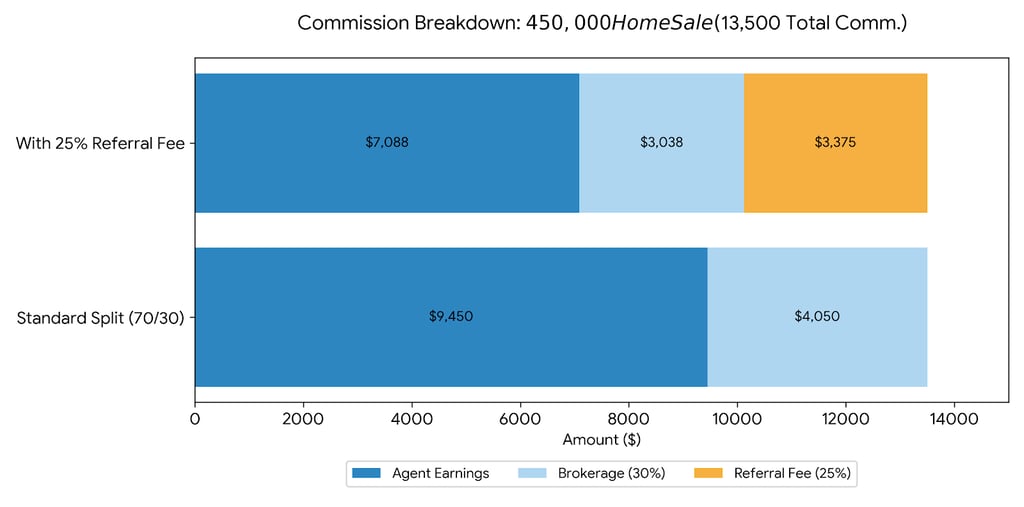
Example: $450,000 Home Sale
If a home sells for $450,000 and the agent represents one side of the transaction:
Sale price: $450,000
Agent commission (3%): $13,500
Brokerage split: 70/30
Estimated agent earnings: $9,450
If the agent also pays a 25% referral fee, the referral is deducted first before the brokerage split. In that situation, the agent’s final earnings would be significantly lower.
Use the referral fee impact tool above to estimate earnings after referral deductions.
Source: realestateagentcalculators.com